
Glacier Diesel Power Updated Electric Lift Pump Kit | 1998.5–2002 Dodge Ram 5.9L Cummins VP44 (P74213)
Description
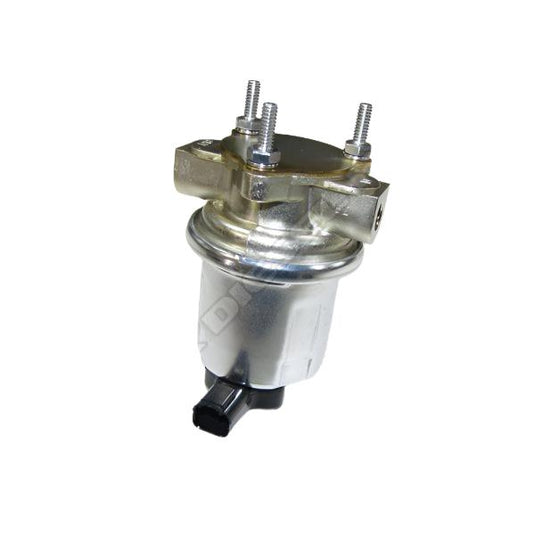
Restore dependable fuel delivery to your 1998.5–2002 Dodge Ram 5.9L Cummins with the Glacier Diesel Power updated electric lift pump kit.
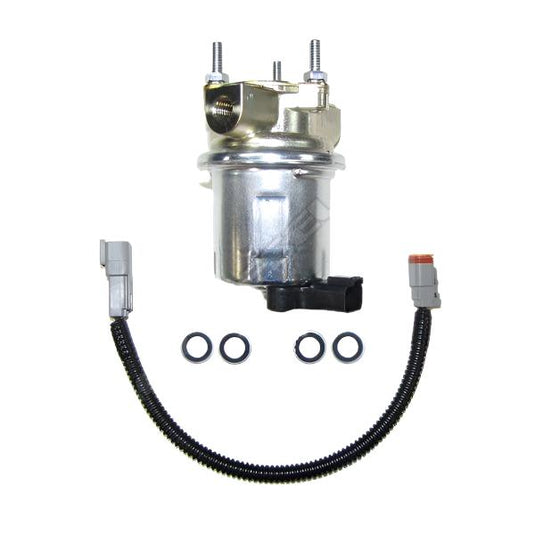
This updated replacement pump supersedes earlier lift-pump designs used on VP44-equipped Cummins trucks. Its rotor housing incorporates an internal bypass circuit, allowing fuel to be drawn through the pump with less restriction if the electric pump becomes inoperative. The kit also includes an extension harness designed to accommodate the applicable model years and four factory-style sealing washers for installation.
The lift pump supplies low-pressure fuel from the tank to the VP44 injection pump. That supply is important not only for engine operation but also for helping circulate fuel through the injection pump. A weak, intermittent, or failed lift pump can contribute to difficult starting, poor performance, pressure loss under load, and increased stress on the VP44.
This kit is intended as a direct replacement solution for trucks retaining the factory-style electric lift-pump arrangement.
Features
- Fits 1998.5–2002 Dodge Ram 2500 and 3500 trucks with the 5.9L Cummins
- Designed for VP44-equipped engines
- Updated electric fuel-transfer pump design
- Supersedes previous pump versions
- Internal bypass passage reduces restriction if the pump stops operating
- Includes extension wiring harness
- Includes four factory-style sealing washers
- Direct replacement for the original engine-mounted lift-pump arrangement
- Replaces Cummins part number 4943048
- Replaces Chrysler part number 5015723AC
- Product SKU: P74213
What Problem Does This Lift Pump Solve?
The VP44 injection system depends on a separate low-pressure supply pump to move fuel from the tank toward the injection pump.
As the original lift pump ages, its electrical motor, internal pumping components, connector, or wiring may deteriorate. A failing pump may still run but no longer provide adequate fuel volume under load. In other cases, it may operate intermittently or stop completely.
Common symptoms can include:
- Extended cranking
- Hard starting
- Loss of power under acceleration
- Fuel-pressure drop under load
- Surging or hesitation
- Intermittent no-start conditions
- Increased lift-pump noise
- A pump that does not run during the commanded prime cycle
Replacing the worn pump restores the factory-style supply path and gives the system a fresh electric transfer pump.
Why the VP44 Needs a Reliable Fuel Supply
The VP44 performs the high-pressure metering and injection functions required to operate the engine, but it does not replace the job of the lift pump.
The electric lift pump must first move fuel from the tank, through the supply circuit, and toward the injection pump. When supply volume is reduced, the VP44 must operate with less incoming fuel than intended.
Fuel-pressure problems are especially likely to appear during:
- Heavy acceleration
- Sustained highway load
- Towing uphill
- Higher engine speed
- Aggressive fueling commands
- Operation with a restricted fuel filter
A truck may appear to run normally at idle while losing fuel supply when demand rises. For that reason, lift-pump diagnosis should not rely solely on whether the pump can be heard running.
What Makes This the Updated Version?
Earlier replacement pumps could create significant inlet restriction if the electric motor or pumping section stopped operating.
This updated design incorporates an internal bypass circuit within the rotor housing. If the pump becomes inoperative, the bypass provides a less-restrictive path through the pump assembly than earlier designs.
The bypass should be viewed as a protective design feature—not as permission to continue operating indefinitely with a failed lift pump.
The VP44 still requires proper fuel supply. If the electric pump stops working, the underlying failure should be diagnosed and repaired immediately.
Glacier Tech Tip
Do not assume the lift pump is healthy simply because it makes noise.
An electric pump can run while producing inadequate pressure or volume. The most useful test is to observe fuel pressure during the conditions where the truck experiences the problem.
Check pressure during:
- Key-on or commanded prime
- Cranking
- Warm idle
- Normal cruise
- Moderate acceleration
- Wide-open throttle or heavy load, when safely possible
A pump that maintains pressure at idle but loses it under load may be worn, restricted at the inlet, supplied with insufficient voltage, or working against a plugged fuel filter.
Internal Bypass: What It Does and Does Not Do
What the Bypass Does
If the electric pump becomes inoperative, the internal passage helps reduce the restriction created by the stationary pump assembly. This may allow fuel to be drawn through the housing more easily than with previous pump designs.
What the Bypass Does Not Do
The bypass does not:
- Turn the pump into a passive long-term fuel system
- Guarantee adequate VP44 supply pressure
- Correct a plugged filter
- Repair failed wiring
- Eliminate the need for a functioning lift pump
- Protect the injection pump from continued low-pressure operation
If the pump fails, diagnose the system rather than relying on the bypass.
Common Causes of Lift-Pump Problems
Normal Pump Wear
The electric motor and pumping assembly wear with use. Output may gradually decline before the pump stops completely.
Restricted Fuel Filter
A contaminated filter increases restriction and can make a healthy pump appear weak.
Low Voltage
Corroded wiring, damaged connectors, poor grounds, or excessive resistance may prevent the pump from receiving full operating voltage.
Air Intrusion
Loose connections or deteriorated hoses on the suction side can allow air into the fuel system without producing an obvious external leak.
Restricted Tank Pickup
Contamination, damaged components, or an undersized pickup path can limit fuel before it reaches the pump.
Contaminated Fuel
Water, debris, corrosion, or microbial contamination can damage the pump and restrict filters.
Fuel System Diagnostic Tip
A complete diagnosis should evaluate both the electrical and hydraulic sides of the system.
Electrical Checks
Verify:
- Battery condition
- Pump voltage during operation
- Ground integrity
- Connector condition
- Harness continuity
- Commanded pump operation
Fuel-System Checks
Inspect:
- Fuel filter condition
- Supply hoses
- Banjo fittings and internal passages
- Tank pickup
- Sealing washers
- Air intrusion
- Pressure at idle and under load
Replacing the pump without correcting a restriction or wiring fault may lead to repeated problems.
What Is Included?
The kit includes:
- Updated electric lift pump
- Extension wiring harness covering the applicable years
- Four factory-style sealing washers
Applications and Fitment
Designed for:
- 1998.5 Dodge Ram 2500 5.9L Cummins
- 1998.5 Dodge Ram 3500 5.9L Cummins
- 1999 Dodge Ram 2500/3500 5.9L Cummins
- 2000 Dodge Ram 2500/3500 5.9L Cummins
- 2001 Dodge Ram 2500/3500 5.9L Cummins
- 2002 Dodge Ram 2500/3500 5.9L Cummins
Intended for trucks equipped with the 24-valve 5.9L Cummins and VP44 injection system.
Replacement Part Numbers
This pump replaces:
- Cummins 4943048
- Chrysler/Mopar 5015723AC
Mopar identifies 5015723AC as a fuel-transfer pump, and the part supersedes 5015723AB.
Always compare the existing pump, electrical connection, fuel connections, and vehicle application before installation.
Installation Notes
Before installation:
- Disconnect the batteries.
- Clean the area around the pump and fuel connections.
- Prevent dirt from entering open fuel lines.
- Replace the supplied sealing washers rather than reusing crushed washers.
- Route the extension harness away from exhaust heat, moving parts, and sharp edges.
- Ensure the electrical connector is fully seated.
- Prime the system before extended cranking.
- Start the engine and inspect every connection for leakage.
- Verify fuel pressure after installation.
Do not overtighten banjo bolts or fittings. Excessive torque can damage threads, fittings, sealing surfaces, or the pump housing.
Important Notes
- This is a factory-style electric replacement lift pump.
- It is not a Fuel Boss mechanical lift-pump system.
- It is not intended to support every high-horsepower application.
- The internal bypass is a reduced-restriction fail-safe feature, not a substitute for pump operation.
- Replace the fuel filter if its condition or service history is unknown.
- Diagnose low voltage, restrictions, and air intrusion before condemning the pump.
- Verify the correct application before ordering.
- This product is currently listed as a preorder item on the Glacier Diesel Power website.
Common Failure Point: Ignoring Fuel Pressure Until the VP44 Has a Problem
One of the most expensive mistakes on a VP44 truck is waiting for a drivability problem before checking lift-pump performance.
A weak supply pump may deteriorate gradually. The engine can continue running while fuel pressure falls farther under load. Because the decline is progressive, the driver may not notice the change until the truck begins hesitating, losing power, or experiencing starting problems.
A permanently installed gauge or periodic pressure testing can reveal a supply problem before it becomes a roadside failure.
Is This the Correct Pump for Your Truck?
This pump is a strong choice when:
- The truck is a 1998.5–2002 24-valve Cummins.
- It retains the factory-style engine-mounted electric lift pump.
- The original pump is weak, leaking, intermittent, or inoperative.
- You need the updated replacement with the internal bypass design.
- You want the extension harness and sealing washers included.
This may not be the correct solution when:
- The truck has been converted to an in-tank pump.
- It already uses a Fuel Boss mechanical system.
- It has a different aftermarket lift-pump arrangement.
- The concern is caused by wiring, a plugged filter, or a restricted tank pickup.
- The engine combination requires more supply capacity than a factory-style pump can provide.
Complete Your VP44 Fuel System
Pair this lift pump with the appropriate Glacier Diesel Power service and diagnostic components:
- Fuel-pressure gauge or test kit
- Fuel-pressure sender fitting
- Replacement fuel filter
- Fuel-filter housing components
- High-flow tank pickup assembly
- Fuel-system sealing washers
- Banjo fittings and adapters
- Fuel Boss mechanical lift-pump system
- Fuel Boss base kit
- Supply and return hose components
The Glacier Diesel Power P74213 Updated Lift Pump Kit provides a direct factory-style replacement for 1998.5–2002 VP44 Cummins trucks. Its updated internal bypass design reduces restriction through the pump if it becomes inoperative, while the included harness and sealing washers help provide a complete, application-focused installation package.
Glacier Diesel Power Updated Electric Lift Pump Kit | 1998.5–2002 Dodge Ram 5.9L Cummins VP44 (P74213)
Description
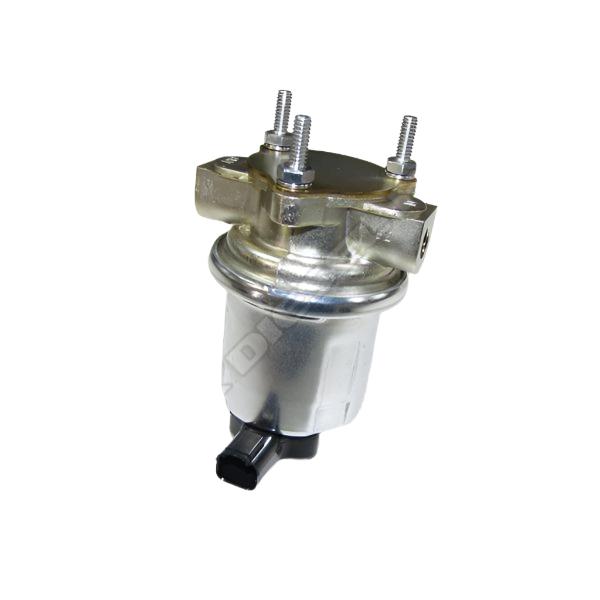
Restore dependable fuel delivery to your 1998.5–2002 Dodge Ram 5.9L Cummins with the Glacier Diesel Power updated electric lift pump kit.
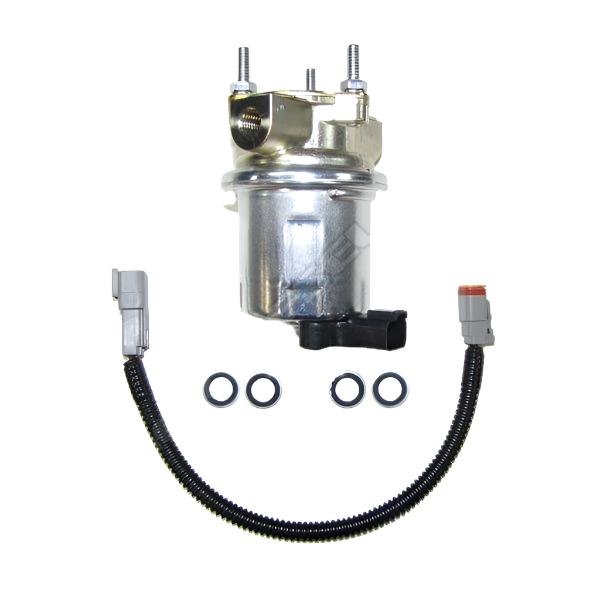
This updated replacement pump supersedes earlier lift-pump designs used on VP44-equipped Cummins trucks. Its rotor housing incorporates an internal bypass circuit, allowing fuel to be drawn through the pump with less restriction if the electric pump becomes inoperative. The kit also includes an extension harness designed to accommodate the applicable model years and four factory-style sealing washers for installation.
The lift pump supplies low-pressure fuel from the tank to the VP44 injection pump. That supply is important not only for engine operation but also for helping circulate fuel through the injection pump. A weak, intermittent, or failed lift pump can contribute to difficult starting, poor performance, pressure loss under load, and increased stress on the VP44.
This kit is intended as a direct replacement solution for trucks retaining the factory-style electric lift-pump arrangement.
Features
- Fits 1998.5–2002 Dodge Ram 2500 and 3500 trucks with the 5.9L Cummins
- Designed for VP44-equipped engines
- Updated electric fuel-transfer pump design
- Supersedes previous pump versions
- Internal bypass passage reduces restriction if the pump stops operating
- Includes extension wiring harness
- Includes four factory-style sealing washers
- Direct replacement for the original engine-mounted lift-pump arrangement
- Replaces Cummins part number 4943048
- Replaces Chrysler part number 5015723AC
- Product SKU: P74213
What Problem Does This Lift Pump Solve?
The VP44 injection system depends on a separate low-pressure supply pump to move fuel from the tank toward the injection pump.
As the original lift pump ages, its electrical motor, internal pumping components, connector, or wiring may deteriorate. A failing pump may still run but no longer provide adequate fuel volume under load. In other cases, it may operate intermittently or stop completely.
Common symptoms can include:
- Extended cranking
- Hard starting
- Loss of power under acceleration
- Fuel-pressure drop under load
- Surging or hesitation
- Intermittent no-start conditions
- Increased lift-pump noise
- A pump that does not run during the commanded prime cycle
Replacing the worn pump restores the factory-style supply path and gives the system a fresh electric transfer pump.
Why the VP44 Needs a Reliable Fuel Supply
The VP44 performs the high-pressure metering and injection functions required to operate the engine, but it does not replace the job of the lift pump.
The electric lift pump must first move fuel from the tank, through the supply circuit, and toward the injection pump. When supply volume is reduced, the VP44 must operate with less incoming fuel than intended.
Fuel-pressure problems are especially likely to appear during:
- Heavy acceleration
- Sustained highway load
- Towing uphill
- Higher engine speed
- Aggressive fueling commands
- Operation with a restricted fuel filter
A truck may appear to run normally at idle while losing fuel supply when demand rises. For that reason, lift-pump diagnosis should not rely solely on whether the pump can be heard running.
What Makes This the Updated Version?
Earlier replacement pumps could create significant inlet restriction if the electric motor or pumping section stopped operating.
This updated design incorporates an internal bypass circuit within the rotor housing. If the pump becomes inoperative, the bypass provides a less-restrictive path through the pump assembly than earlier designs.
The bypass should be viewed as a protective design feature—not as permission to continue operating indefinitely with a failed lift pump.
The VP44 still requires proper fuel supply. If the electric pump stops working, the underlying failure should be diagnosed and repaired immediately.
Glacier Tech Tip
Do not assume the lift pump is healthy simply because it makes noise.
An electric pump can run while producing inadequate pressure or volume. The most useful test is to observe fuel pressure during the conditions where the truck experiences the problem.
Check pressure during:
- Key-on or commanded prime
- Cranking
- Warm idle
- Normal cruise
- Moderate acceleration
- Wide-open throttle or heavy load, when safely possible
A pump that maintains pressure at idle but loses it under load may be worn, restricted at the inlet, supplied with insufficient voltage, or working against a plugged fuel filter.
Internal Bypass: What It Does and Does Not Do
What the Bypass Does
If the electric pump becomes inoperative, the internal passage helps reduce the restriction created by the stationary pump assembly. This may allow fuel to be drawn through the housing more easily than with previous pump designs.
What the Bypass Does Not Do
The bypass does not:
- Turn the pump into a passive long-term fuel system
- Guarantee adequate VP44 supply pressure
- Correct a plugged filter
- Repair failed wiring
- Eliminate the need for a functioning lift pump
- Protect the injection pump from continued low-pressure operation
If the pump fails, diagnose the system rather than relying on the bypass.
Common Causes of Lift-Pump Problems
Normal Pump Wear
The electric motor and pumping assembly wear with use. Output may gradually decline before the pump stops completely.
Restricted Fuel Filter
A contaminated filter increases restriction and can make a healthy pump appear weak.
Low Voltage
Corroded wiring, damaged connectors, poor grounds, or excessive resistance may prevent the pump from receiving full operating voltage.
Air Intrusion
Loose connections or deteriorated hoses on the suction side can allow air into the fuel system without producing an obvious external leak.
Restricted Tank Pickup
Contamination, damaged components, or an undersized pickup path can limit fuel before it reaches the pump.
Contaminated Fuel
Water, debris, corrosion, or microbial contamination can damage the pump and restrict filters.
Fuel System Diagnostic Tip
A complete diagnosis should evaluate both the electrical and hydraulic sides of the system.
Electrical Checks
Verify:
- Battery condition
- Pump voltage during operation
- Ground integrity
- Connector condition
- Harness continuity
- Commanded pump operation
Fuel-System Checks
Inspect:
- Fuel filter condition
- Supply hoses
- Banjo fittings and internal passages
- Tank pickup
- Sealing washers
- Air intrusion
- Pressure at idle and under load
Replacing the pump without correcting a restriction or wiring fault may lead to repeated problems.
What Is Included?
The kit includes:
- Updated electric lift pump
- Extension wiring harness covering the applicable years
- Four factory-style sealing washers
Applications and Fitment
Designed for:
- 1998.5 Dodge Ram 2500 5.9L Cummins
- 1998.5 Dodge Ram 3500 5.9L Cummins
- 1999 Dodge Ram 2500/3500 5.9L Cummins
- 2000 Dodge Ram 2500/3500 5.9L Cummins
- 2001 Dodge Ram 2500/3500 5.9L Cummins
- 2002 Dodge Ram 2500/3500 5.9L Cummins
Intended for trucks equipped with the 24-valve 5.9L Cummins and VP44 injection system.
Replacement Part Numbers
This pump replaces:
- Cummins 4943048
- Chrysler/Mopar 5015723AC
Mopar identifies 5015723AC as a fuel-transfer pump, and the part supersedes 5015723AB.
Always compare the existing pump, electrical connection, fuel connections, and vehicle application before installation.
Installation Notes
Before installation:
- Disconnect the batteries.
- Clean the area around the pump and fuel connections.
- Prevent dirt from entering open fuel lines.
- Replace the supplied sealing washers rather than reusing crushed washers.
- Route the extension harness away from exhaust heat, moving parts, and sharp edges.
- Ensure the electrical connector is fully seated.
- Prime the system before extended cranking.
- Start the engine and inspect every connection for leakage.
- Verify fuel pressure after installation.
Do not overtighten banjo bolts or fittings. Excessive torque can damage threads, fittings, sealing surfaces, or the pump housing.
Important Notes
- This is a factory-style electric replacement lift pump.
- It is not a Fuel Boss mechanical lift-pump system.
- It is not intended to support every high-horsepower application.
- The internal bypass is a reduced-restriction fail-safe feature, not a substitute for pump operation.
- Replace the fuel filter if its condition or service history is unknown.
- Diagnose low voltage, restrictions, and air intrusion before condemning the pump.
- Verify the correct application before ordering.
- This product is currently listed as a preorder item on the Glacier Diesel Power website.
Common Failure Point: Ignoring Fuel Pressure Until the VP44 Has a Problem
One of the most expensive mistakes on a VP44 truck is waiting for a drivability problem before checking lift-pump performance.
A weak supply pump may deteriorate gradually. The engine can continue running while fuel pressure falls farther under load. Because the decline is progressive, the driver may not notice the change until the truck begins hesitating, losing power, or experiencing starting problems.
A permanently installed gauge or periodic pressure testing can reveal a supply problem before it becomes a roadside failure.
Is This the Correct Pump for Your Truck?
This pump is a strong choice when:
- The truck is a 1998.5–2002 24-valve Cummins.
- It retains the factory-style engine-mounted electric lift pump.
- The original pump is weak, leaking, intermittent, or inoperative.
- You need the updated replacement with the internal bypass design.
- You want the extension harness and sealing washers included.
This may not be the correct solution when:
- The truck has been converted to an in-tank pump.
- It already uses a Fuel Boss mechanical system.
- It has a different aftermarket lift-pump arrangement.
- The concern is caused by wiring, a plugged filter, or a restricted tank pickup.
- The engine combination requires more supply capacity than a factory-style pump can provide.
Complete Your VP44 Fuel System
Pair this lift pump with the appropriate Glacier Diesel Power service and diagnostic components:
- Fuel-pressure gauge or test kit
- Fuel-pressure sender fitting
- Replacement fuel filter
- Fuel-filter housing components
- High-flow tank pickup assembly
- Fuel-system sealing washers
- Banjo fittings and adapters
- Fuel Boss mechanical lift-pump system
- Fuel Boss base kit
- Supply and return hose components
The Glacier Diesel Power P74213 Updated Lift Pump Kit provides a direct factory-style replacement for 1998.5–2002 VP44 Cummins trucks. Its updated internal bypass design reduces restriction through the pump if it becomes inoperative, while the included harness and sealing washers help provide a complete, application-focused installation package.