
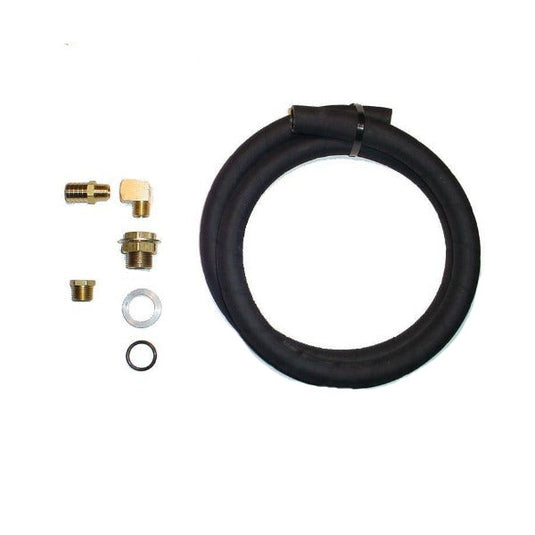
Glacier Diesel Power 2003–2012 Dodge Ram 5.9L / 6.7L Cummins Fuel Tank Vent Kit (0307-TVK)
Description
If you've ever stood at the fuel pump waiting for the last few gallons to slowly trickle into your tank, you've experienced one of the most common frustrations with 2003–2012 Dodge Ram diesel trucks.
The factory fuel tank vent is positioned in a way that can trap an air pocket near the top of the tank during refueling. As fuel level rises, the trapped air has difficulty escaping fast enough, causing the fuel nozzle to repeatedly shut off long before the tank is truly full. Many owners spend several extra minutes slowly topping off the final few gallons just to maximize driving range.
The Glacier Diesel Power Fuel Tank Vent Kit relocates the tank vent to the highest point of the fuel tank, allowing trapped air to escape more efficiently during refueling. This simple modification makes it possible to fill the tank completely without the constant stop-and-start cycle that many owners experience at the pump. Most customers report being able to utilize an additional 3 to 4 gallons of the factory tank capacity while significantly reducing fueling time.
Every kit includes premium 3/4-inch fuel-rated hose along with durable brass and steel fittings. Unlike plastic fittings that can become brittle with age, the Glacier system is built using high-quality components designed for years of dependable service.
Whether your truck is a daily driver, tow rig, work truck, or long-distance hauler, the Fuel Tank Vent Kit helps you spend less time standing at the pump and more time on the road.
Features
- Fits 2003–2012 Dodge Ram 2500 and 3500 5.9L & 6.7L Cummins
- Relocates the fuel tank vent to the highest point of the tank
- Helps eliminate slow fill-ups and repeated fuel nozzle shutoff
- Allows more complete use of factory fuel tank capacity
- Many users gain access to approximately 3–4 additional gallons during refueling
- Premium 3/4-inch fuel-rated hose
- High-quality brass and steel fittings
- No plastic plumbing components
- Durable, corrosion-resistant construction
- Complete installation hardware included
Why Upgrade Your Fuel Tank Vent?
A diesel fuel tank must be able to vent displaced air while fuel is entering.
As fuel flows into the tank, the air occupying the upper portion of the tank must escape. If it cannot vent quickly enough, pressure builds inside the tank and the fuel nozzle interprets this as a full tank, automatically shutting off.
Many 2003–2012 Ram owners are familiar with the routine:
- Fill until the nozzle clicks off.
- Wait for foam and trapped air to settle.
- Slowly trickle fuel into the tank.
- Repeat several times before finally leaving the station.
The factory tank often still has usable expansion volume remaining, but trapped air prevents it from filling efficiently.
The Glacier Fuel Tank Vent Kit addresses this by relocating the vent to a higher position, allowing air to evacuate more effectively during refueling. The result is faster fills, fewer nozzle shutoffs, and more usable fuel before your next stop.
Glacier Tech Tip
Many owners mistakenly believe their fuel gauge is inaccurate because they can never add the advertised tank capacity.
In reality, the gauge is often working correctly. The problem is that the tank simply cannot vent efficiently enough during refueling to utilize all of its available expansion volume.
If your truck consistently requires slow "trickle filling" for the last several gallons, poor venting is usually the cause—not the fuel gauge.
Relocating the vent allows trapped air to escape naturally instead of compressing inside the tank during filling.
Why Glacier Built It This Way
The Fuel Tank Vent Kit was designed around durability and long-term reliability.
Rather than relying on lightweight plastic fittings, Glacier uses quality brass and steel components that provide excellent corrosion resistance and stand up well to years of exposure underneath the truck.
The 3/4-inch fuel-rated hose provides an unrestricted vent path while remaining flexible enough for clean routing during installation.
Most importantly, the vent is relocated to the highest practical point on the tank. Since air naturally rises, this allows trapped air to escape where it wants to go instead of remaining trapped beneath the incoming fuel.
It's a simple engineering solution to a frustrating everyday problem.
How the Vent Kit Improves Refueling
The Fuel Tank Vent Kit does not increase the physical size of your fuel tank.
Instead, it helps you use more of the capacity that already exists.
During factory fueling, trapped air can occupy several gallons of space near the top of the tank. The vent relocation allows that trapped air to escape more efficiently so incoming fuel can occupy that volume instead.
For many owners, this means:
- Less waiting at the fuel pump
- Fewer automatic nozzle shutoffs
- More complete fill-ups
- Longer driving range between fuel stops
- A better overall fueling experience
Actual additional fuel capacity will vary depending on vehicle configuration, pump speed, fueling technique, and individual truck tolerances.
Applications
Designed for:
- 2003 Dodge Ram 2500 5.9L Cummins
- 2003 Dodge Ram 3500 5.9L Cummins
- 2004 Dodge Ram 2500 5.9L Cummins
- 2004 Dodge Ram 3500 5.9L Cummins
- 2004.5 Dodge Ram 2500 5.9L Cummins
- 2004.5 Dodge Ram 3500 5.9L Cummins
- 2005 Dodge Ram 2500 5.9L Cummins
- 2005 Dodge Ram 3500 5.9L Cummins
- 2006 Dodge Ram 2500 5.9L Cummins
- 2006 Dodge Ram 3500 5.9L Cummins
- 2007 Dodge Ram 2500 5.9L Cummins
- 2007 Dodge Ram 3500 5.9L Cummins
- 2007.5 Dodge Ram 2500 6.7L Cummins
- 2007.5 Dodge Ram 3500 6.7L Cummins
- 2008 Dodge Ram 2500/3500/4500/5500 6.7L Cummins
- 2009 Dodge Ram 2500/3500/4500/5500 6.7L Cummins
- 2010 Dodge Ram 2500/3500/4500/5500 6.7L Cummins
- 2011 Ram 2500/3500/4500/5500 6.7L Cummins
- 2012 Ram 2500/3500/4500/5500 6.7L Cummins
Important Notes
- Designed for 2003–2012 Dodge Ram diesel trucks.
- Installation requires lowering the fuel tank.
- This modification utilizes unused expansion space already built into the factory tank.
- It does not increase the physical size of the fuel tank.
- Fueling improvement varies depending on pump flow rate and vehicle configuration.
- Follow all installation instructions carefully.
Common Failure Point
Many owners assume repeated nozzle shutoff is caused by the fuel station or the fuel pump itself.
In reality, the issue is usually the truck's inability to vent trapped air quickly enough during refueling. The factory vent location allows air to become trapped near the top of the tank, slowing the filling process and preventing the tank from reaching its practical capacity.
The Fuel Tank Vent Kit addresses this bottleneck by providing a more effective vent path during refueling.
Complete Your Fuel System
Complete your Glacier Diesel Power fuel system with:
- Glacier Fuel Boss Mechanical Lift Pump
- Glacier MK-2 Fuel Filter System
- Glacier Twin Fuel Filter System
- Glacier Severe Service Twin Fuel Filter System
- Glacier Big Line Kits
- Fuel Pressure Gauge and Sender
- Fuel Pressure Test Fittings
- Replacement Fleetguard Fuel Filters
Glacier Diesel Power 2003–2012 Dodge Ram 5.9L / 6.7L Cummins Fuel Tank Vent Kit (0307-TVK)
Description
If you've ever stood at the fuel pump waiting for the last few gallons to slowly trickle into your tank, you've experienced one of the most common frustrations with 2003–2012 Dodge Ram diesel trucks.
The factory fuel tank vent is positioned in a way that can trap an air pocket near the top of the tank during refueling. As fuel level rises, the trapped air has difficulty escaping fast enough, causing the fuel nozzle to repeatedly shut off long before the tank is truly full. Many owners spend several extra minutes slowly topping off the final few gallons just to maximize driving range.
The Glacier Diesel Power Fuel Tank Vent Kit relocates the tank vent to the highest point of the fuel tank, allowing trapped air to escape more efficiently during refueling. This simple modification makes it possible to fill the tank completely without the constant stop-and-start cycle that many owners experience at the pump. Most customers report being able to utilize an additional 3 to 4 gallons of the factory tank capacity while significantly reducing fueling time.
Every kit includes premium 3/4-inch fuel-rated hose along with durable brass and steel fittings. Unlike plastic fittings that can become brittle with age, the Glacier system is built using high-quality components designed for years of dependable service.
Whether your truck is a daily driver, tow rig, work truck, or long-distance hauler, the Fuel Tank Vent Kit helps you spend less time standing at the pump and more time on the road.
Features
- Fits 2003–2012 Dodge Ram 2500 and 3500 5.9L & 6.7L Cummins
- Relocates the fuel tank vent to the highest point of the tank
- Helps eliminate slow fill-ups and repeated fuel nozzle shutoff
- Allows more complete use of factory fuel tank capacity
- Many users gain access to approximately 3–4 additional gallons during refueling
- Premium 3/4-inch fuel-rated hose
- High-quality brass and steel fittings
- No plastic plumbing components
- Durable, corrosion-resistant construction
- Complete installation hardware included
Why Upgrade Your Fuel Tank Vent?
A diesel fuel tank must be able to vent displaced air while fuel is entering.
As fuel flows into the tank, the air occupying the upper portion of the tank must escape. If it cannot vent quickly enough, pressure builds inside the tank and the fuel nozzle interprets this as a full tank, automatically shutting off.
Many 2003–2012 Ram owners are familiar with the routine:
- Fill until the nozzle clicks off.
- Wait for foam and trapped air to settle.
- Slowly trickle fuel into the tank.
- Repeat several times before finally leaving the station.
The factory tank often still has usable expansion volume remaining, but trapped air prevents it from filling efficiently.
The Glacier Fuel Tank Vent Kit addresses this by relocating the vent to a higher position, allowing air to evacuate more effectively during refueling. The result is faster fills, fewer nozzle shutoffs, and more usable fuel before your next stop.
Glacier Tech Tip
Many owners mistakenly believe their fuel gauge is inaccurate because they can never add the advertised tank capacity.
In reality, the gauge is often working correctly. The problem is that the tank simply cannot vent efficiently enough during refueling to utilize all of its available expansion volume.
If your truck consistently requires slow "trickle filling" for the last several gallons, poor venting is usually the cause—not the fuel gauge.
Relocating the vent allows trapped air to escape naturally instead of compressing inside the tank during filling.
Why Glacier Built It This Way
The Fuel Tank Vent Kit was designed around durability and long-term reliability.
Rather than relying on lightweight plastic fittings, Glacier uses quality brass and steel components that provide excellent corrosion resistance and stand up well to years of exposure underneath the truck.
The 3/4-inch fuel-rated hose provides an unrestricted vent path while remaining flexible enough for clean routing during installation.
Most importantly, the vent is relocated to the highest practical point on the tank. Since air naturally rises, this allows trapped air to escape where it wants to go instead of remaining trapped beneath the incoming fuel.
It's a simple engineering solution to a frustrating everyday problem.
How the Vent Kit Improves Refueling
The Fuel Tank Vent Kit does not increase the physical size of your fuel tank.
Instead, it helps you use more of the capacity that already exists.
During factory fueling, trapped air can occupy several gallons of space near the top of the tank. The vent relocation allows that trapped air to escape more efficiently so incoming fuel can occupy that volume instead.
For many owners, this means:
- Less waiting at the fuel pump
- Fewer automatic nozzle shutoffs
- More complete fill-ups
- Longer driving range between fuel stops
- A better overall fueling experience
Actual additional fuel capacity will vary depending on vehicle configuration, pump speed, fueling technique, and individual truck tolerances.
Applications
Designed for:
- 2003 Dodge Ram 2500 5.9L Cummins
- 2003 Dodge Ram 3500 5.9L Cummins
- 2004 Dodge Ram 2500 5.9L Cummins
- 2004 Dodge Ram 3500 5.9L Cummins
- 2004.5 Dodge Ram 2500 5.9L Cummins
- 2004.5 Dodge Ram 3500 5.9L Cummins
- 2005 Dodge Ram 2500 5.9L Cummins
- 2005 Dodge Ram 3500 5.9L Cummins
- 2006 Dodge Ram 2500 5.9L Cummins
- 2006 Dodge Ram 3500 5.9L Cummins
- 2007 Dodge Ram 2500 5.9L Cummins
- 2007 Dodge Ram 3500 5.9L Cummins
- 2007.5 Dodge Ram 2500 6.7L Cummins
- 2007.5 Dodge Ram 3500 6.7L Cummins
- 2008 Dodge Ram 2500/3500/4500/5500 6.7L Cummins
- 2009 Dodge Ram 2500/3500/4500/5500 6.7L Cummins
- 2010 Dodge Ram 2500/3500/4500/5500 6.7L Cummins
- 2011 Ram 2500/3500/4500/5500 6.7L Cummins
- 2012 Ram 2500/3500/4500/5500 6.7L Cummins
Important Notes
- Designed for 2003–2012 Dodge Ram diesel trucks.
- Installation requires lowering the fuel tank.
- This modification utilizes unused expansion space already built into the factory tank.
- It does not increase the physical size of the fuel tank.
- Fueling improvement varies depending on pump flow rate and vehicle configuration.
- Follow all installation instructions carefully.
Common Failure Point
Many owners assume repeated nozzle shutoff is caused by the fuel station or the fuel pump itself.
In reality, the issue is usually the truck's inability to vent trapped air quickly enough during refueling. The factory vent location allows air to become trapped near the top of the tank, slowing the filling process and preventing the tank from reaching its practical capacity.
The Fuel Tank Vent Kit addresses this bottleneck by providing a more effective vent path during refueling.
Complete Your Fuel System
Complete your Glacier Diesel Power fuel system with:
- Glacier Fuel Boss Mechanical Lift Pump
- Glacier MK-2 Fuel Filter System
- Glacier Twin Fuel Filter System
- Glacier Severe Service Twin Fuel Filter System
- Glacier Big Line Kits
- Fuel Pressure Gauge and Sender
- Fuel Pressure Test Fittings
- Replacement Fleetguard Fuel Filters